Table of Contents
One philosophy is making you richer and more miserable. The other is napping in a sunbeam. We should talk.
Somewhere along the way, a hunting metaphor became a life philosophy.
“Eat what you kill.”
You’ve heard it. Maybe you’ve said it. It shows up in sales meetings, on LinkedIn, in the mouths of people who equate constant metaphorical hunting and killing with success. The idea is simple: you earn exactly what you generate. No kill, no eat. No grind, no reward.
It sounds tough. Honest, even. And for a long time, many very smart people wore it like a badge of honor.
This is the story of what that badge actually costs. And why the creature sleeping on your couch may have quietly figured out a more sustainable philosophy than anyone on Wall Street or the corner suite cold have known.

What does ‘eat what you kill’ actually mean?
The phrase started, literally, as a hunting ethic — the principle that you shouldn’t take a life you don’t intend to use. Business culture borrowed it and inverted it into something far more predatory.
The earliest documented business use traces back to a 1987 article in The American Lawyer, describing law firm compensation models where each partner’s pay was tied directly to the revenue they personally generated. No communal pool. No lockstep seniority. You eat what you kill. Full stop.
From law firms, it migrated to Wall Street. From Wall Street, into startup culture. From startup culture, onto LinkedIn, into sales training rooms, into self-help books with titles like “Becoming a Sales Carnivore.” The 2025 version of that book, published by Penguin Random House, encourages readers to activate their “prey drive” and distinguish themselves from “herbivores — victims who make excuses.” Or put another way, people who hunt plants, not animals.
When someone invokes “eat what you kill” as a badge today, they’re encoding something specific: self-reliance as a supreme virtue. Zero-sum thinking. Competition as natural law. The idea that if you’re not hunting, you’re prey.
“I eat everything I kill, and I am a killer… I’ve got all the freedom and power money can buy, but I am here today begging for your help. I hate myself.” — Wall Street professional, quoted by Dr. Alden CassThat quote is from a psychologist who works with high-earning finance professionals. His patient was earning millions. He was also, quietly, coming apart. Wonder why?
That’s not an isolated case. It’s a pattern.

The hidden cost of hustle culture
Here’s what the data says about sustained “eat what you kill” living:
- 745,000 people died from overwork in a single year — from stroke and heart disease caused by working 55+ hours per week (WHO/ILO, 2021). A 29% increase since 2000.
- Productivity sharply declines after 50 hours per week. After 55 hours, the additional output is virtually zero. You’re just paying the biological cost without the return.
- 82% of employees are currently at risk of burnout. Nearly half across eight countries say they’re already experiencing it.
- Gen Z is hitting peak burnout at age 25 — seventeen years earlier than previous generations.
And then there’s the psychological architecture underneath the numbers. A landmark 2024 study across 10,000+ participants in six countries found that the zero-sum mindset — the core of “eat what you kill” thinking — predicts not just less cooperation but also meaningfully lower subjective well-being and lower economic growth. The competitive worldview makes everyone poorer, including the most aggressive competitor.
Their most striking finding: zero-sum thinking predicted lower cooperation even in situations where cooperation was a matter of life and death.
Biologically, the mechanism is cortisol. Chronic stress keeps the body’s HPA axis activated, as Harvard Health study describes it, “a motor that is idling too high for too long.” Constant status competition — the defining feature of predatory professional cultures — keeps cortisol chronically elevated. Over time, this leads to immune dysregulation, inflammation, cardiovascular disease, and cognitive decline. The hunt, sustained indefinitely, becomes the hunter’s undoing.
The philosopher Byung-Chul Han put it plainly in The Burnout Society: “Achievement society is the society of self-exploitation. The achievement-subject exploits itself until it burns out.”
It’s worth sitting with that for a moment. Not as a verdict. Just as a question worth asking: what exactly is being won, and at what price?

What dogs teach us about a better way to live
Here’s the thing about dogs. They don’t hustle.
They sleep 12 to 14 hours a day. They play without keeping score. They greet you with the same uncomplicated joy whether you’ve had your best day or your worst. They don’t accumulate. They’re satisfied with enough — a meal, a walk, a warm patch of sunlight.
This is easy to dismiss as sentimentality. It’s not. It’s neuroscience.
A 2015 study published in Science found that mutual gazing between dogs and humans triggers reciprocal increases in oxytocin — the same neurochemical bonding loop that connects human mothers and infants. Wolves showed no such effect, even when hand-raised. Dogs have co-evolved with humans to broadcast biological cues of safety and connection. When your dog looks at you, your brain physically shifts toward a calmer state.
And that shift is measurable. Just 10 minutes of petting a dog reduces cortisol levels significantly (Washington State University, 2019). Dogs present during a social stress test led to 50% lower cortisol response than the control group (University of Denver). A meta-analysis of 3.8 million people found that dog ownership was associated with a 24% lower risk of all-cause mortality and a 31% lower risk of cardiovascular death.
Dogs were found to be more effective at reducing stress than romantic partners, parents, or close friends.That’s not a small thing. The creature you’re probably stressed about being able to afford to feed is outperforming your entire social support network as a physiological regulator.
And it’s not just about the stress relief. Dogs embody a complete alternative operating system. The late primatologist Frans de Waal spent decades demonstrating that cooperation, empathy, and fairness are not soft aberrations from nature — they’re its baseline. Humans and other primates are, by default, cooperators. Selfishness comes secondarily, as a learned overlay.
Robert Axelrod’s famous Computer Prisoner’s Dilemma Tournament found the same thing in game theory: when strategies competed across thousands of iterations, the simplest cooperative approach — Tit-for-Tat — won twice. All eight top-ranking strategies were “nice.” The aggressive strategies burned out their resources and led to a loss.
Axelrod’s conclusion: “Real life is not zero-sum.”
Your dog already knew this. It’s the factory setting.
Stuart Brown, M.D., who spent decades studying play, opens his landmark book with the image of a golden retriever racing across a lawn as the quintessence of what play actually is. His most quoted finding: “The opposite of play is not work. It’s depression.” Dogs play throughout their entire lives, without requiring productivity justification. Play is its own reward. Rest is its own return.
Even the scientist who popularized the “alpha wolf” myth — the original intellectual grandfather of “eat what you kill” pack dynamics — has publicly renounced it. Natural wolf packs are cooperative family units, not competitive hierarchies. All pack members have access to food regardless of rank. The predatory hierarchy was a fiction. The cooperation was always the truth.
THiNK LiKE A DOG: a sustainable alternative to hustle culture
We’re not suggesting you quit your job and take a four-hour nap. Though, that said, the nap is not a bad idea. Plus, it’s healthy, too.
What we’re pointing toward is something more foundational: a different operating assumption about what makes a life feel good over time.
The “eat what you kill” philosophy is built on scarcity. Every meal is earned by hunting and killing, whether real, or metaphorical. Nothing is ever enough because the environment is always potentially hostile, and the moment you stop hunting, you starve. This is not a mindset anyone consciously chooses. It’s a mindset that gets installed — by culture, by compensation structures, by the slow accumulation of a million messages that say your worth is intrinsically tied to your output.
The dog philosophy runs on a different assumption: that enough is actually enough. That rest is not laziness — it’s recovery. That connection is not a strategy — it’s the point. That the present moment, this walk, this meal, this warm room, is not a consolation prize for failing to accumulate more. It’s the whole game. It’s the natural status quo.
The philosopher Epicurus called this “static pleasure” — the contentment of no longer wanting. Joseph Heller named it “enough.” Your dog has been living it all along. Right there on your couch.
Your dog has no job security, no 401(k), and no retirement plan. And yet, every day, it lives with more presence, more joy, and more physiological calm than most humans manage in a week.That’s not an indictment of ambition. It’s a recalibration of what success actually looks like in a body that has to live with the consequences of it.
What we know from the burnout research, the game theory, the cortisol studies, and the evolutionary biology all point in the same direction: the “eat what you kill” philosophy is not only making people miserable — it’s not even winning on its own terms. Cooperative strategies outperform competitive ones over time. Zero-sum thinking correlates with worse outcomes for everyone, including the predator.
The dog figured this out 15,000 years ago when it chose to cooperate with humans over competing against them. That choice is the reason the species thrives.

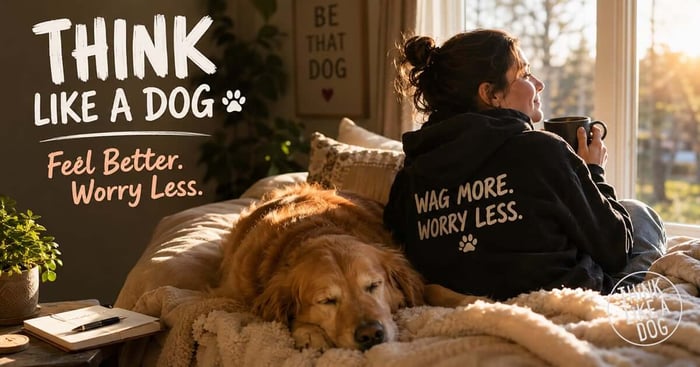
Feel Better. THiNK LiKE A DOG®
We build dog-inspired apparel and content for people who are tired of the grind and quietly suspect their dog is living more wisely than they are.
The tagline is “Feel Better. THiNK LiKE A DOG.” It’s five words, but it’s also a complete philosophy: that the path to feeling better isn’t more hustle, more optimization, or more kill or be killed. It’s a shift in operating assumptions. Toward presence. Toward enough. Toward the kind of uncomplicated joy your dog brings to the exact same nap, walk, or sniff, every single day.
You don’t have to stop working hard. You don’t have to abandon ambition. You just have to stop treating every moment as a hunt and every person as potential prey.
Your dog isn’t googling “hustle culture alternatives” at 2 a.m.
Your dog is already there. Join them.
Feel Better. THiNK LiKE A DOG.®
FAQs
What does "eat what you kill" actually mean as a life philosophy?
Originally a hunting ethic, "eat what you kill" was adopted by law firms in the 1980s to describe compensation models where partners earned only what they personally generated. From there it migrated into Wall Street, sales culture, and eventually mainstream hustle culture — where it became shorthand for a zero-sum worldview: you earn exactly what you take, and if you stop hunting, you starve. As a life philosophy, it encodes self-reliance as supreme virtue, competition as natural law, and scarcity as the permanent operating condition. The research suggests it's also quietly making the people who live by it miserable.
Is "think like a dog" actually a sustainable alternative to hustle culture, or is it just a feel-good idea?
It's backed by harder science than most hustle philosophies are. Cooperative strategies consistently outperform competitive ones over time — Robert Axelrod's game theory research demonstrated this across thousands of iterations. Zero-sum thinking correlates with lower wellbeing and lower economic growth even for the most aggressive competitors (Stanford/UBC, 2024, 10,000+ participants). Dogs specifically reduce cortisol more effectively than partners, parents, or close friends. The "feel-good" framing undersells what's actually a more durable operating system.
What does dog behavior actually teach us about stress and burnout?
Quite a bit. Dogs naturally spend roughly 80% of their time in rest or gentle presence — cycling between bursts of play and deep parasympathetic recovery without guilt or justification. They broadcast biological cues of safety (soft eyes, relaxed posture) that shift the human nervous system out of fight-or-flight. A 2015 study in Science found that mutual gazing between dogs and humans triggers the same oxytocin bonding loop found between mothers and infants. Dogs don't model passivity — they model recovery, and recovery is what makes sustained performance possible.
Why is "eat what you kill" culture unsustainable in the long run?
The fight-or-flight response is designed for acute, short-term threats — not as a permanent operating mode. Sustained predatory competition keeps cortisol chronically elevated, leading to immune dysregulation, cardiovascular disease, and cognitive decline over time. Productivity drops sharply after 50 hours per week and reaches virtually zero after 55. The WHO found that overwork killed more than 745,000 people in a single year. Beyond the biology, the philosophy is also self-defeating: in repeated game theory simulations, aggressive zero-sum strategies consistently lose to cooperative ones. It's not a sustainable hunt. It's a slow burn.
What is THiNK LiKE A DOG® and who is it for?
THiNK LiKE A DOG® is a dog-inspired wellness and apparel brand built around a single idea: when life gets heavy, you can feel better by thinking more like your dog. The tagline is Feel Better. THiNK LiKE A DOG. It's for people who love their dogs deeply, are tired of the grind, and have a quiet suspicion that the creature napping on their couch has figured something out that they haven't. The apparel and content serve as daily reminders to shift toward presence, playfulness, and the kind of uncomplicated joy dogs bring to the exact same walk every single day.